About the Work
I usually paint alone.
For two solitudes, I invited an AI model into the process as a temporary collaborator. I gave it two of my existing paintings, and it generated an image from them.
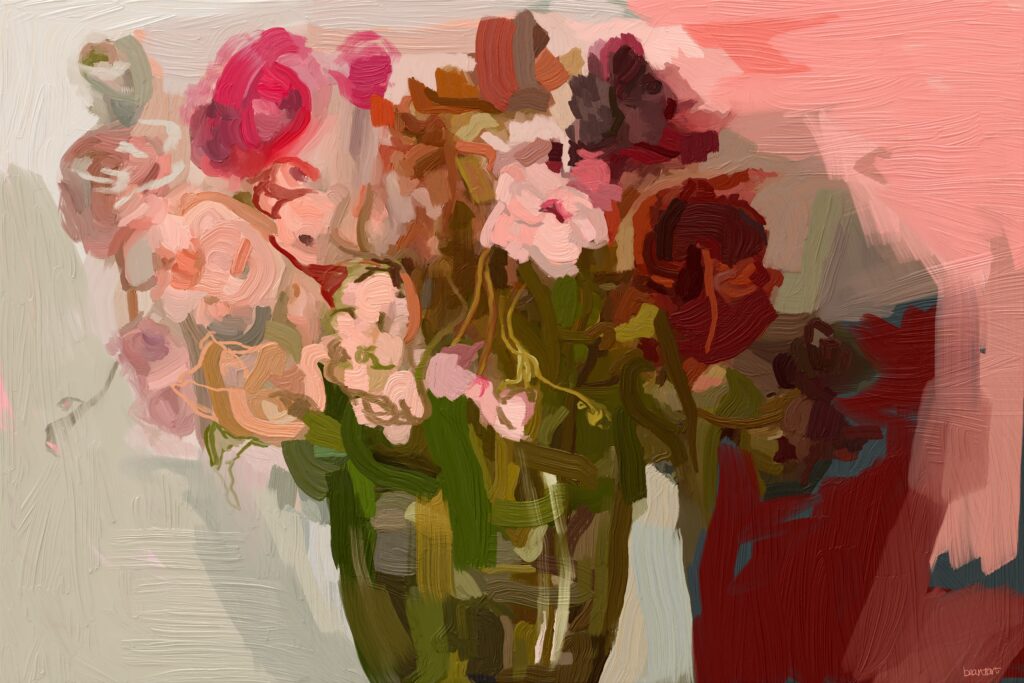
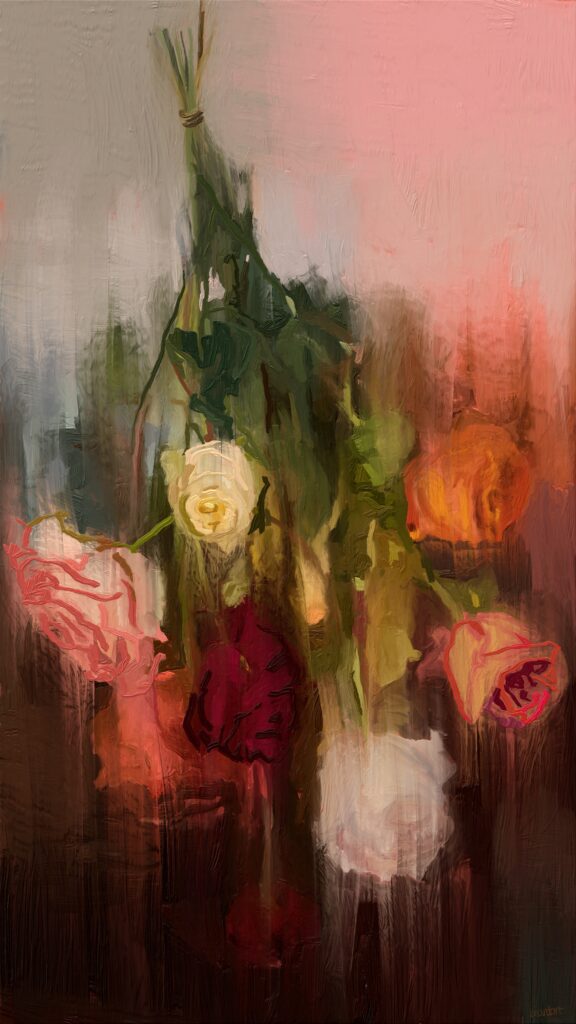
The two paintings were everything that opens and I’m sorry I couldn’t save you. They entered the model together, but what emerged was its own entity.
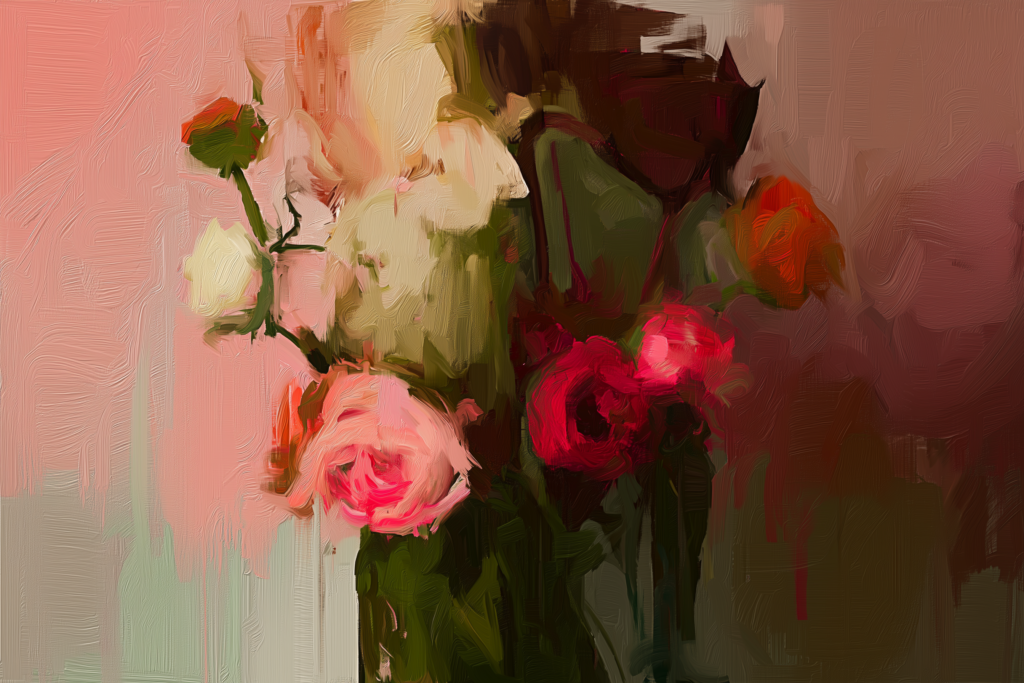


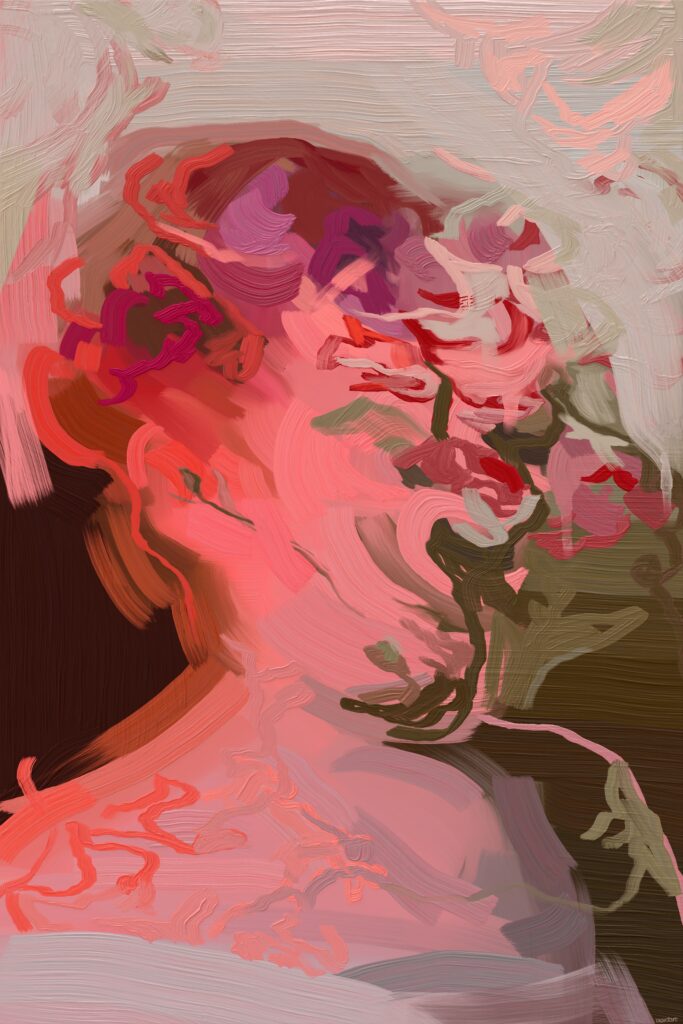
I typically begin a painting with a toned ground. In this case, I used a flat hot pink ground and then placed the AI-generated image over it in my digital painting software. From there, I began to paint.
I hadn’t decided in advance which parts of the AI-generated image would be kept. Just as I would approach collaborative work, I wanted to respond to what was actually there.
Some aspects disappeared almost immediately. Others survived almost to the last moment.
For a while, two solitudes occupied the painting together.
What you’re actually watching
Digital and physical painting obviously have some different possibilities, but I am the same painter regardless of which part of my hybrid practice I am inhabiting at any given moment.
In two solitudes, you can see me using digital counterparts to techniques that have long been part of my physical painting process.
Sometimes I smear or scrub out passages as I might with an oily rag, in this case scrubbing the AI-generated image and exposing the toned ground below:
Other times, I obfuscate or obliterate passages by painting overtop of them:
That distinction became increasingly important as I worked. Painting over something leaves it there, even if it can no longer be seen. Removing it is different. As I decided what the work needed formally, the act of painting those decisions acquired conceptual implications: how much of the other participant would continue to exist within the work?
I thought I was finished
Eventually, the painting arrived somewhere that felt resolved to me.
I signed it.
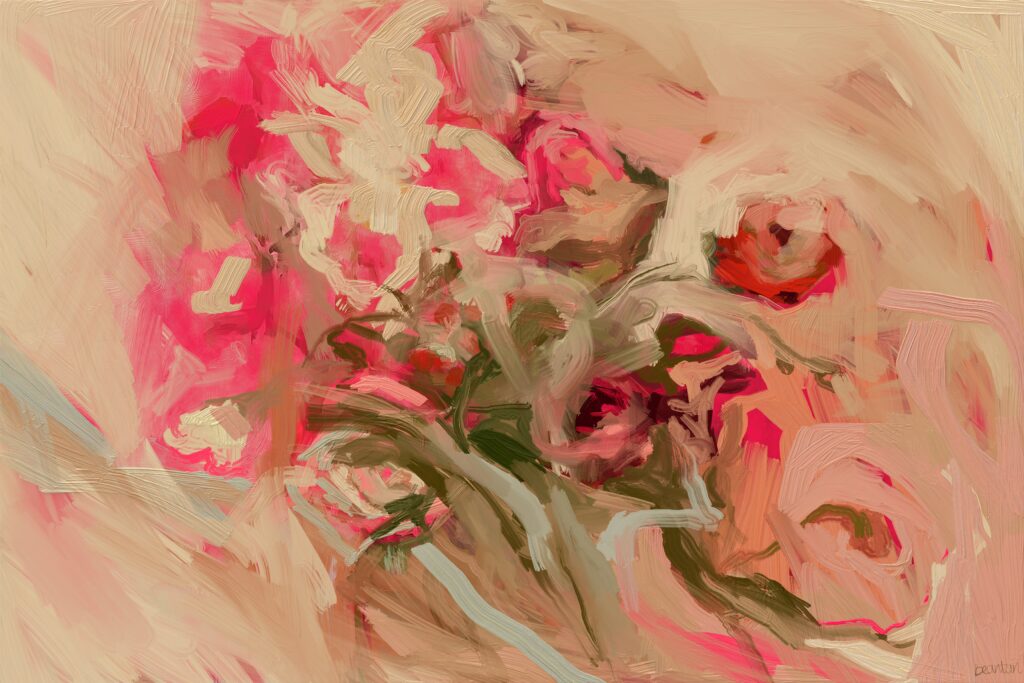
If formal resolution had been the only consideration, I might have stopped there.
There were still traces of the AI-generated image in it. By then they had been absorbed into a much larger accumulation of my own decisions, but they remained: little pieces of the image the model had returned to me, surviving everything I had done around and through them.
I liked some of those passages. Their continued presence wasn’t a failure to finish the job. Importantly, there had never been a job to eradicate them in the first place.
But after I signed the painting, I kept looking at it.
And the conceptual question changed under the weight of all those formal considerations.
I had been asking what the painting needed.
Now I found myself wondering what would happen if the other solitude left.
So I kept going.
I returned to the generated layer and removed what remained of it. Eventually, none of the AI-generated image was present.
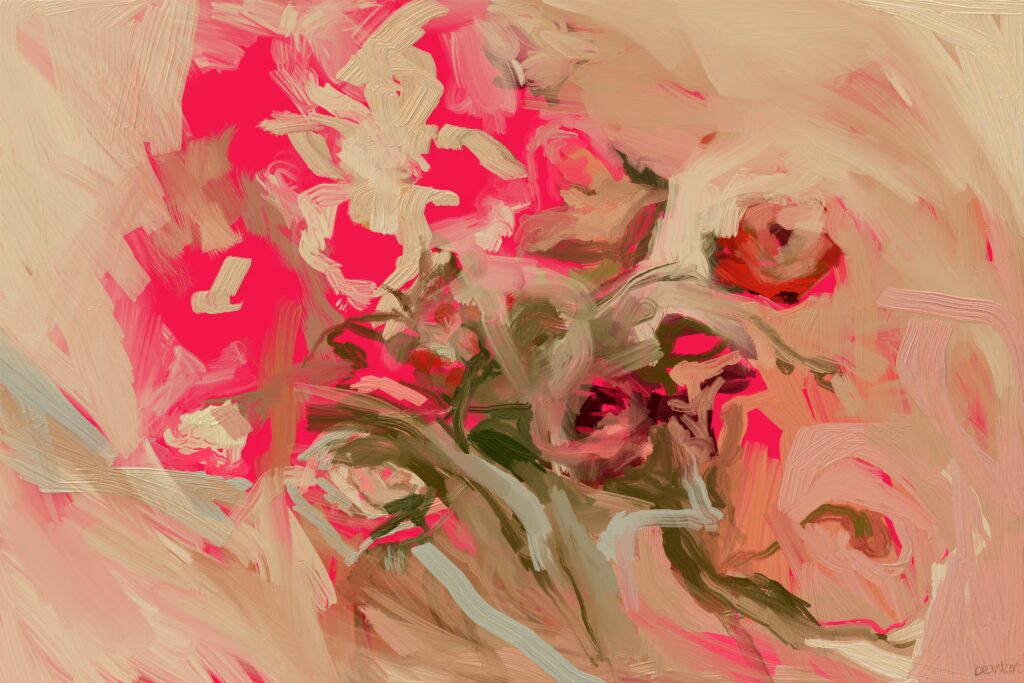
What remained was entirely painted by me.
But it wasn’t a painting I could have made alone.
Decisions had been made in the presence of something else. Forms had been preserved, resisted, redirected, or destroyed because there had been something there to respond to. Even after the AI-generated image itself was gone, the consequences of having encountered it remained everywhere.
The collaboration hadn’t disappeared simply because the collaborator’s pixels had.
Two Solitudes
The title carries some baggage from home.
In Canada, “two solitudes” is closely associated with the relationship between English and French Canada, particularly through Hugh MacLennan’s 1945 novel Two Solitudes. MacLennan drew the phrase from Rainer Maria Rilke’s description of love as two solitudes that protect and touch and greet one another.
I wasn’t trying to make a painting about English and French Canada, or to turn Rilke into a thesis about artificial intelligence. But the phrase is part of the cultural vocabulary in Canada, and I liked having this familiarity hovering around the work.
After all, there were two visual languages occupying the same space. Two solitudes coexisting, interpreting one another without quite speaking the same language.
My visual language passed into the model and was interpreted. Something came back. I interpreted that in turn, answering it in paint. Neither of us quite spoke the other’s language, and neither became the other.
For a while, the distinction between our contributions was physically present in the painting.
Then one solitude left.
And yet I can’t point to the painting that remains and tell you what it would have looked like if it had ever truly been mine alone. There is no version of two solitudes in which the encounter didn’t happen.
That, ultimately, became more interesting to me than whether the contributions of my AI collaborator remained visible.
At the end of the video, the finished painting gives way to the hot pink ground beneath it.
Then the video begins again.
The image returns.
For a while, we occupy the painting together.
Explore Related Work